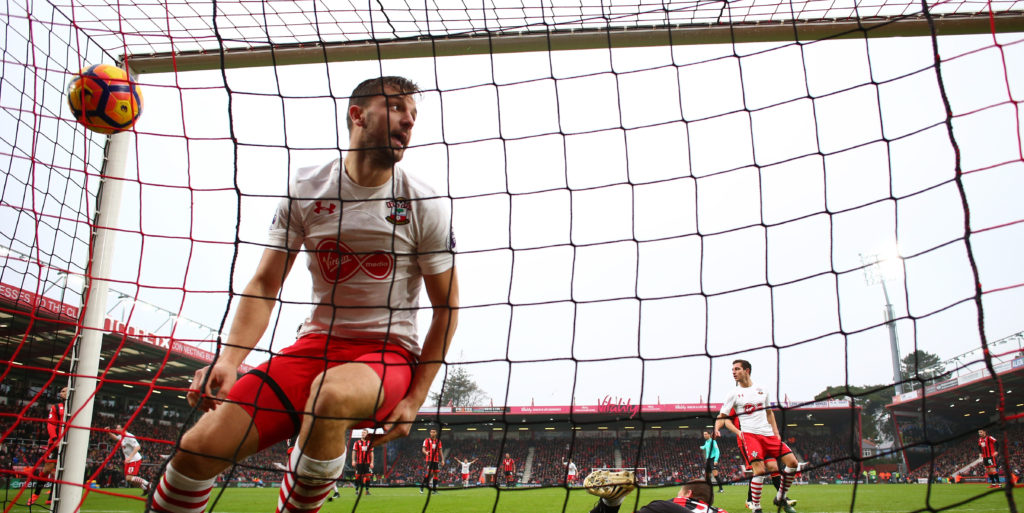

Southampton got back to winning ways on Sunday afternoon as they swept aside Bournemouth with a 3-1 victory.
Nathan Ake opened the scoring for the hosts but an equaliser from Ryan Bertrand followed by a brace from Jay Rodriguez helped Saints to clinch all three points.
It was a much better showing from Claude Puel’s side, who looked to be much sharper and switched on throughout.
I had a deeper look into how Saints improved their performance and how they were too difficult for Bournemouth to beat on the day.
The persistent pressing from Saints
Earlier on in the season, one of our most impressive aspects was the pressing; we were relentless in closing the opposition down and allowing them no space on the ball.
In recent weeks, that has slowed down a bit and we’ve came across a bit more conservative in our approach and slightly less reluctant to push on and get up in the opponents’ faces.
However against Bournemouth, the mentality and the intensity changed and it clearly showed through the pressing from the whole team. 
From the first minute to the last, it was clear that we wanted to grab the game by the scruff of the neck and protect the ball, whilst suffocating Bournemouth of space when they did have possession.
By doing this, we were able to reclaim the ball quicker and counter-press more efficiently and effectively, restricting Bournemouth’s natural philosophy to exploit space in behind with the pace at their disposal as they had no time to pick passes and find vacated space in the defence, if it were to present itself.
Van Dijk’s variety in press-resistance
A key player all season for Saints has been Virgil van Dijk and although he wasn’t in the thick of the action on Sunday, largely because he didn’t need to be, he still demonstrated his composure and intelligence.
We all know that he’s superb at bringing the ball out from the back and this match was no different, as he once again flexed his tactical muscle in the first-half. 
By continuously looking to drive the ball forward, van Dijk allows the players behind him to re-organise and solidify the defensive unit whilst he carries the ball. Along with this, he pushes his team upfield in order to find dangerous positions in attack, with the Dutchman transitioning from the first phase of build-up into the second almost seamlessly, penetrating Bournemouth’s initial press.
Not only does van Dijk impress with his ball carrying through the lines, but his ability to use the ball when in a deeper position is also something to be admired.
His vision and composure are two pivotal aspects of his game and he continuously puts them to good use by relieving the pressure from his team, finding cute passes between the space that Bournemouth’s poor organisation allowed him to exploit. 
This kind of awareness and vision to pick out vertical passes through the midfield to the likes of Pierre-Emile Hojbjerg also helps Saints transition defence into attack in efficient fashion, once again reinforcing van Dijk’s quality on the ball and cementing his place as the league’s best ball-playing central defender at the moment.
The understanding of role
It’s been quite clear to see that in recent weeks, Puel has altered the system slightly and has alternated his usual diamond midfield system with a traditional 4-3-3, maintaining a fluid and interchangeable front three.
However, what has remained the same throughout every single one of the 26 matches that Saints have played this season is the utilisation of the six in the team dropping deeper than the two eight’s, Clasie and Hojbjerg in this case.
Young Harrison Reed started in the holding midfield role as the six and although he was substituted at half-time for struggling to cope with the tempo of the game, perhaps a lack of inexperience, he still showed a good understanding and a good knowledge of Puel’s philosophy. 
Since the beginning of the season, the defensive midfielder has slotted in a little deeper than what the normal pivot would, often deploying himself as an auxiliary central defender.
This has been much the case with Oriol Romeu this season but it was also clear to see with Reed on the day, who positioned himself in the middle of Maya Yoshida and van Dijk, enabling Saints to work forwards from a back three.
It’s always been a fascinating aspect of Puel’s setup and it continues to work well and offer Saints protection in any case. Reed or Romeu always have the pitch ahead of them to pick out teammates and initiate the attacks from deep, along with the added protection and knowledge that if they do happen to lose the ball, there are three defenders in effect to retaliate with a counter-press or to contain the opposition, restricting them from breaking away into an effective counter attack.
Attacking importance of full-backs
Much akin to the positioning of the defensive midfielder, Puel’s natural footballing philosophy involves a lot of work down the flanks despite his regular tendency to play without wingers, mainly from the full-backs.
However, just like the pressing has in recent weeks, the involvement of full-backs pushing high up the pitch and threatening their opposition defenders had regressed somewhat.
Now, this isn’t to say that the full-backs have not been getting forward to support the attacking movements, because they have. Cedric Soares and Bertrand have both been getting into crossing positions in recent weeks, but the Bournemouth game showed more shades of how they operated at the start of the season.
As I previously alluded to, the pair have been getting up the pitch well however, they haven’t been doing it in a way that can really hurt the opposition. 
It was a high tempo match between Saints and Bournemouth on Sunday and that meant that counter-attacks were fairly regular. This meant that we had to push bodies up the pitch consistently in order to gain numerical superiority over Bournemouth when attacking.
This was where Cedric and Bertrand added a lot, as they were further advanced and helped to contribute in the build-up whilst The Cherries were disorganised from their previous attack, meaning that the duo had space out wide to threaten and potentially double up on either Simon Francis or Charlie Daniels.
By doing this, Saints retained the ball in a much sharper fashion, pushed on faster and found more attacking positions. This was much like the game away at West Ham earlier on in the season, where the full-backs were able to comfortably exploit the space whenever it arose because they were already positioned well in attacking phases.
Hojbjerg’s tactical intelligence
Although Hojbjerg didn’t have his best game in a Southampton shirt, he still displayed tremendous intelligence as he seems to do in every game he plays.
He had perhaps the worst first-half of his Saints career so far, followed by a much better second, but he still demonstrated just why he is such a valuable cog in the Saints midfield with some wonderful awareness and press resistance.
Hojbjerg’s excellent quality with his back to goal is something that is often made the most of by the young Dane, who played a one-two with Maya Yoshida in order to suck in a total of three Bournemouth players in the midfield, only to pull away into space and receive the ball again, initiating an attack. 
Although the following pass from Hojbjerg was well intercepted, the methodical and innovative approach that he takes to the game has been a breath of fresh air and as he continues to mature, develop and adjust to the English game, I’m sure his creativity will be reciprocated in his performance as it is in his mind.
It’s no less than what we should expect from a Pep Guardiola protege, but his tactical intelligence continues to impress and if he can simply sharpen up his decision making at times and his focus, which was often taken advantage of in the first-half, he’ll nail down a position in the middle for Saints.
Saints’ pragmatism in closing the game out
Whilst it’s never great to see us sitting back and inviting pressure from an opposition, we did it on Sunday superbly well with a structured, well-organised defensive block that allowed no room for Bournemouth to operate in.
The Cherries were often found 25-yards from goal and without a real idea of where to go due to how deep Saints did sit and how well they shut out the threat. 
The midfield line came to within five-yards of the back four and this meant that there was no way for Bournemouth to really find an opening between the lines and no way for them to break down the sturdy Saints defence.
Having defensive blocks as low as this is normally something that I’d personally discourage but in the circumstances of the match and given its tempo, frustrating Bournemouth was the correct way to go about things and it was Saints’ discipline that saw them allow The Cherries no clear-cut opportunities throughout.




Comments.
Loading comments…